Democracy in Motion
The Ring and the Ballot Box

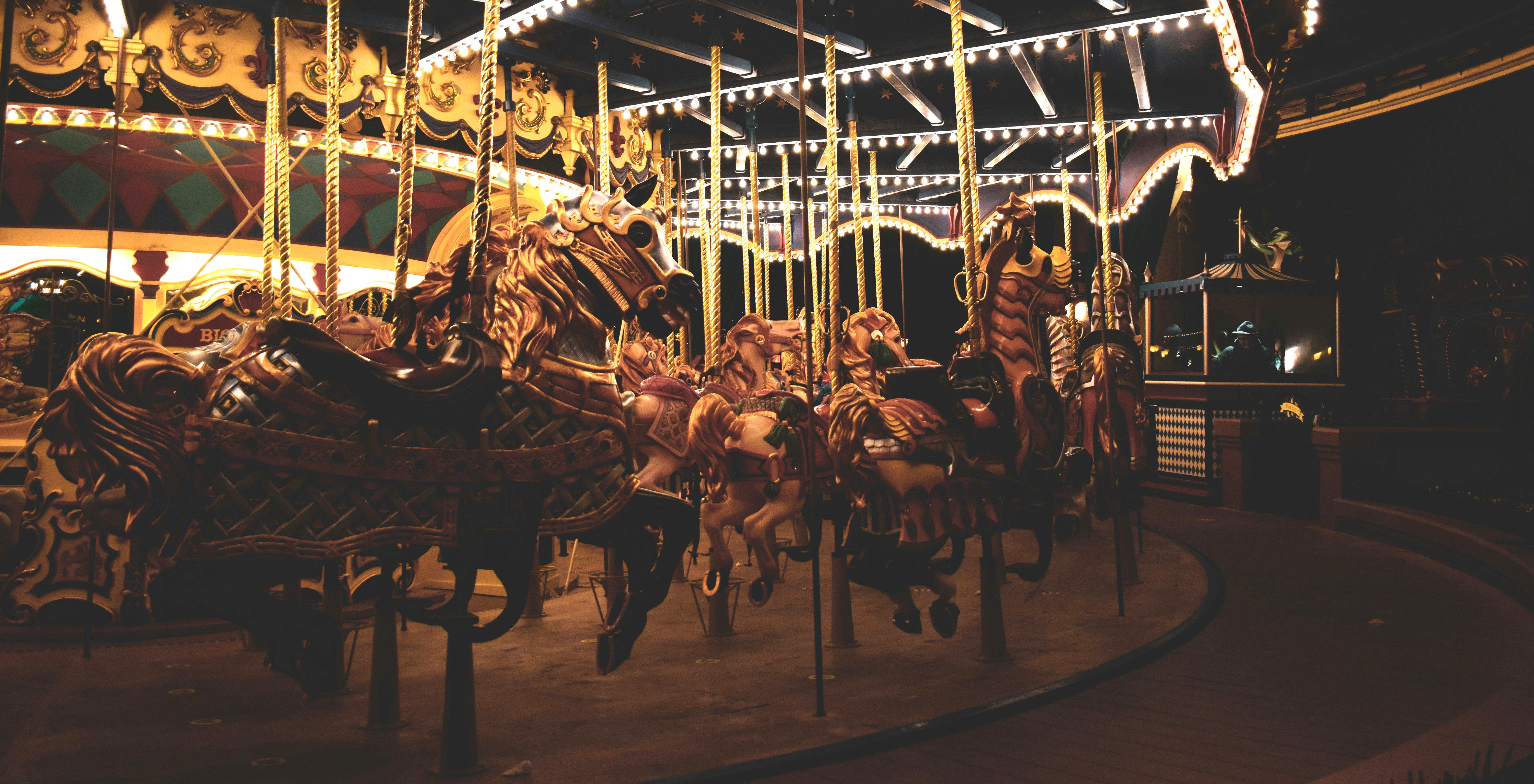
Lying in bed recently, trying to sleep, I allowed myself a childlike bedtime story. I pictured a carousel whose gears operate society. Trump rides a mechanical horse, circling endlessly. He stretches out his hand as far as he can without falling, balancing like Humpty Dumpty on the wall, reaching for the gold and shiny ring -- a prize riders on old carousels tried to grab as they passed.
Again and again he comes around, his hand reaching not with the delight of a child but with desperation. Up and down and around he goes, trying to grab the ring. Just beneath it, I picture a box with a narrow slit -- a ballot box. Each time, just as he reaches for the ring, someone steps forward and drops a ballot inside.
Citizens have the authority to govern. In a democracy, the way each person exercises this right and responsibility is by casting a vote.
From the moment Reagan came to office announcing his belief that government is bad, the right and opportunity to vote have been under attack. If voting in the midterms this year is prevented or manipulated so that people cannot govern themselves, Trump and the donor billionaires cooperating with him will be free to do as they please for their personal enrichment and in support of the hidden agenda. Such is the movement begun by Reagan–Thatcher neoliberalism, and it remains the goal of the small group who today constitute a narrow class of extreme personal wealth.
The business community and many people of significant wealth have engaged in an effort to remove the people’s exercise of government, for it is the people who possess the authority to act as the body politic and regulate them. It may have begun with a desire to eliminate government oversight, but Reaganism led directly to the dangerous place where we are today. The danger of neoliberalism’s growth into a partnership between a single ruler and those with the wealth to block the will of the majority can be seen in the unregulated growth of monopolies that control the economy, the government, and ultimately the culture.
What is happening to the power of the vote -- the only way the people can counter the movement toward control by a ruling class of the super-wealthy? From the very beginning of Reagan-Thatcher neoliberalism, the ultimate design has been to prevent, or render meaningless, votes cast in opposition to their vision of radical privatization. Reaganomics has been followed so faithfully that the United States of today is steadily removing power from Congress and the courts and placing government securely in the hands of the economic elite. It has reached the point where the combined power of the president and the dominating realm of economics are willing to simply ignore votes that go against their wishes and do what they want anyway.
Obstruction of voting has been an effective strategy since the Reagan administration, which used various methods to suppress the votes of Black, Hispanic, and other minority citizens who were eligible and eager to vote. Consider the number of ways in which the Reagan administration operated.
In 1981, during the New Jersey gubernatorial election, signs warning of voter-fraud penalties were posted near minority precincts in plain sight of voters. Local sheriffs and off-duty police officers were stationed at polling places. The threat of their presence was heightened by the highly visible black armbands worn by each officer, with “National Ballot Security Task Force” printed on them. All of this was the work of the Republican National Committee.
But this was not all. The scare tactics also involved about 200,000 letters designed to appear official and marked “Return to Sender.” They were sent to voters in heavily Black and Latino districts. Many recipients, believing they were responding to instructions from government officials and acting in the interests of “National Ballot Security,” returned them. Those who did had their names added to a list of voters to be challenged at the polls on Election Day. This commonly used tactic is called “caging.” There were additional tactics of voter subversion. About 200 poll watchers were deployed statewide, many of them uniformed and carrying guns.
One telling example of this abuse of authority occurred in Trenton, the state capital, where patrol members demanded that a Black voter produce her registration card. When she could not, they turned her away. Latino voters were similarly blocked from voting by “officials” in Vineland, while in the state’s largest city, Newark, some voters were physically chased away from the polls by patrol members.
In 1982, “caging” letters similar to those sent the year before were mailed to predominantly Black and Latino neighborhoods across New Jersey. In response, the Democratic National Committee and the New Jersey Democratic State Committee brought legal action, resulting in a consent decree restricting the Republican National Committee’s ballot-security activities, including the use of caging. This decree remained in effect for 36 years, expiring in 2018. The results of the midterm elections of 1982 were a setback for the “Reagan Revolution,” but not a landslide rejection. The Democratic Party gained 26 seats in the House, while Republicans maintained their Senate majority despite small losses.
I return in my mind to that carousel. Donald Trump desperately leaning for the gold ring, reaching for absolute power, while the people continue placing ballots into the box. The carousel spins, the gears of society turn, and the prize will remain just out of reach. People still have the authority to act, to vote, and to shape the ride. No matter how far he reaches, democracy will keep moving, and each vote is a hand steadying the course.
Ideas like these are best explored together. Share your thoughts. I read and respond to every comment.
As long as there is democracy, and as long as there ever was, suppressing votes has been a practiced (and sound) strategy. Just trying to make a person feel less enthusiastic about voting is something every politician does (we focus on physical manifestations while always ignoring the psychological ones we call "campaigning"). How far it should go is another question.
Campaigns are too long. They are full of negative information - much of it false - about the other candidate, trying to convince people whom the campaigner knows won't vote for them to at least stay home. Is there any campaign without a strategy to suppress the other side's vote? I doubt it, at least in closer districts.
Physical impediments are easy to point out - union goons and Klan members by a ballot box are, of course, wrong. Police? I think so. Political party members? Too much for me. All intimidation or overly-stringent requirements (time or ID) ruin democracy to some degree. But maybe we should start talking about campaigning. Not just getting corporate money out of it, but getting rid of campaigns altogether (or nearly).
I don't have a solution off-hand, and just thinking about this cost me too much time at work. But I want us all to start thinking about "campaigning" (beyond corporate influence) as a threat to democracy.
Currently, the big voter suppression tactic is the SAVE act. I agree with Butch that the campaigns are too long. We are contantly bombarded through all kinds of media to contribute to candidates that we don't even know. Politics has become invasive. We need to work on the business of living and helping all people to live better. I know that involves participation in the political sphere, but right now we are being buried by it.