Whales, Alligators, and Flags
Politics... What's It Got To Do With Me?

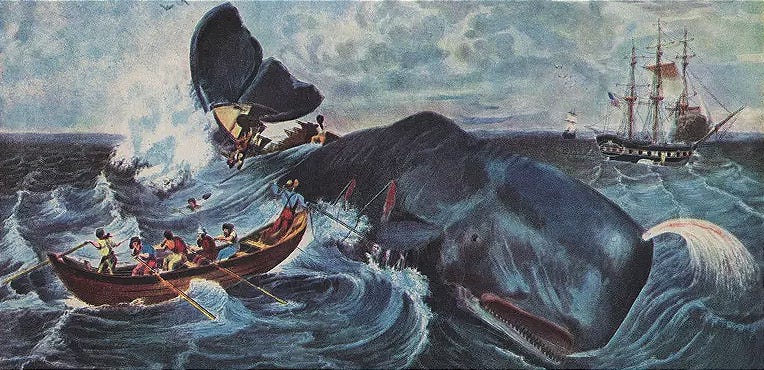
Imagine being alone and helpless in wide, deep, open sea waters. You feel something large and powerful rising from the depths, suddenly the surface breaking open with a roar. Bursting upward is a great sea monster—a whale, an ocean-alligator, one of the great leviathans as described in scripture. In 1651, Thomas Hobbes used this threatening image to describe the nature of government: a great Leviathan. Fear, not shared participation, was assumed to be the basis of social life. It was a vision in which individual rights and liberties were sacrificed for protection, peace, and order.
Forty years later, John Locke wrote about government as democracy. In his vision, people are free, possessing rights and liberties granted as a birthright and protected by institutions formed by the majority, the will of fellow citizens. It is a picture of community, of shared participation, with flags flying.
During his first presidential campaign, Donald Trump portrayed American democracy as a swamp. Such a swamp may be manageable for a dictator, but it is neither just nor secure, and certainly nothing a citizen would want to step into. Across his last two administrations, the swamp has grown dangerously, rising around our feet as the muck and the mire creep and crawl up the legs of the body politic. From the shadows, the eyes of the swamp alligator watch confidently. While wading through these murky waters, we must remember that we have “nothing to fear but fear itself.” For fear and its consequences drive government into even deeper waters and darker swamps.
The worst effect of accepting that government is “bad” is the apathy that it establishes, working directly against civic participation. Growing numbers of Americans feel little reason to “fight city hall,” and fewer and fewer of the young, the poor, and the marginalized are motivated to vote, much less to engage politically. Having seen so little result from their democratic choices, many feel there is no point in choosing between candidates or taking the trouble to go to the polls. The length, breadth, and depth of apathy among young people over the last two generations is shocking and desperately dangerous for good government. Too many people are following Reagan’s logic, ultimately concluding that government is something to cower from, ignore, or oppose. It becomes a danger to be feared and avoided, pushed into the background of ordinary daily life.
A significant number of people declare themselves apolitical. Aristotle believed that being political, fulfilling one’s duty to the community and the entire human enterprise, was central to the very definition of humanity. To be apolitical, then, is to be sub-human. In a democracy, another way to put it is this: to be apolitical is to be socially amoral. Corruption does not necessarily entail criminal or immoral behavior. A corrupt body of a person can be thought of as diseased, lacking vitality, or even dead and decaying. This sense of the word also can be applied to the institutions of the body politic.
Our collective memory of the Reagan administration is not one of corruption. Few people recall that more Reagan administration appointees and officials went to prison than in any other administration in American history, up to date. Perhaps the all-consuming, years-long Iran-Contra Affair1 has been pushed to the periphery of popular memory. Six of the most important figures involved, including Secretary of Defense Casper Weinberger, accepted pardons.
Notably, it was Attorney General William Barr, the same official who more recently shielded Trump from the consequences of the Mueller report, who issued presidential pardons to these six key Iran-Contra suspects. Those pardons managed to prematurely end the investigation of President Reagan and others. Lawrence Walsh, the independent prosecutor in the case, said of the pardons: “It demonstrates that powerful people with powerful allies can commit serious crimes in high office, deliberately abusing the public trust without consequences.”
Politics has become so degraded in the public mind that citizens assume cheating, power-grabbing, and bribery are normal, and those who think otherwise are told to “get over it!” When we see corruption, we are now too ready to think, “There is nothing to be done about that.” Trump helped make this mindset common and expected; “We can’t blame one politician for doing it when everyone else does.”
Instead of symbolizing public service, personal sacrifice, and patriotism, “politician” has come to stand for self-serving, power-hungry, and greedy officials. Instead of referring to community and decision-making shared by all, “politics” has been degraded into a reference to pretension, deception, and manipulation. Politics and politician are now words few want to be labeled.
One of Reagan’s favorite jokes, especially enjoyed by evangelical audiences, reflected this stigmatization:
“An evangelical minister and a politician arrived at Heaven’s gate together. St. Peter, after doing all the necessary formalities, took them in hand to show them their quarters. He showed the clergyman a small, single room with a bed, a chair, and a table. The politician was becoming a little worried about what might be in store for him. However, he was taken aback when St. Peter stopped in front of a beautiful mansion with lovely grounds and many servants, telling him that these would be his quarters.
He couldn’t help but ask, ‘But wait… there’s something wrong. How do I get this mansion while that good and holy man only gets a single room?’
St. Peter replied, ‘You have to understand how things work up here. We’ve got thousands and thousands of clergy. You’re the first politician who ever made it.’”
If we cannot trust politics, we cannot have representative democracy.
Inherent in the republican form of democracy is citizen participation: citizens must accept the privilege and exercise the responsibility of being politically informed and personally engaged in government for our democracy to function. When enough citizens become convinced that others are running the government—an “establishment” or a “deep state”—a candidate like Trump can appear, declaring that “Government is the problem” and calling it “a swamp.”
The distrust of government is at the center of the slow but steady rise of hopelessness, frustration, and anger that is loose in the land, many fearing the predicted dangers of the future. Upcoming threats such as climate change, the loss of jobs due to artificial intelligence, further digital revolutions, pandemics, and ongoing international conflicts can seem overwhelming if we feel powerless to address them through government.
Don’t get lost in a sea of open waters where the Leviathan might rise up and attack, and avoid the alligators lying in wait within the swamp. Wave the flag!
Senior administration officials secretly facilitated the sale of arms to Iran, which was the subject of an arms embargo. The administration hoped to use the proceeds to fund the Contras, anti-communist warlords in Nicaragua—several of whom were guilty of atrocities. They were responsible for the murder of priests, nuns, and peasants of whole villages, some of them personal acquaintances of a number of us in the Episcopal Church, myself included. Congress had passed a law forbidding arms sales to them, specifically.
Very well said, as always. Keep saying it, my good bishop.